
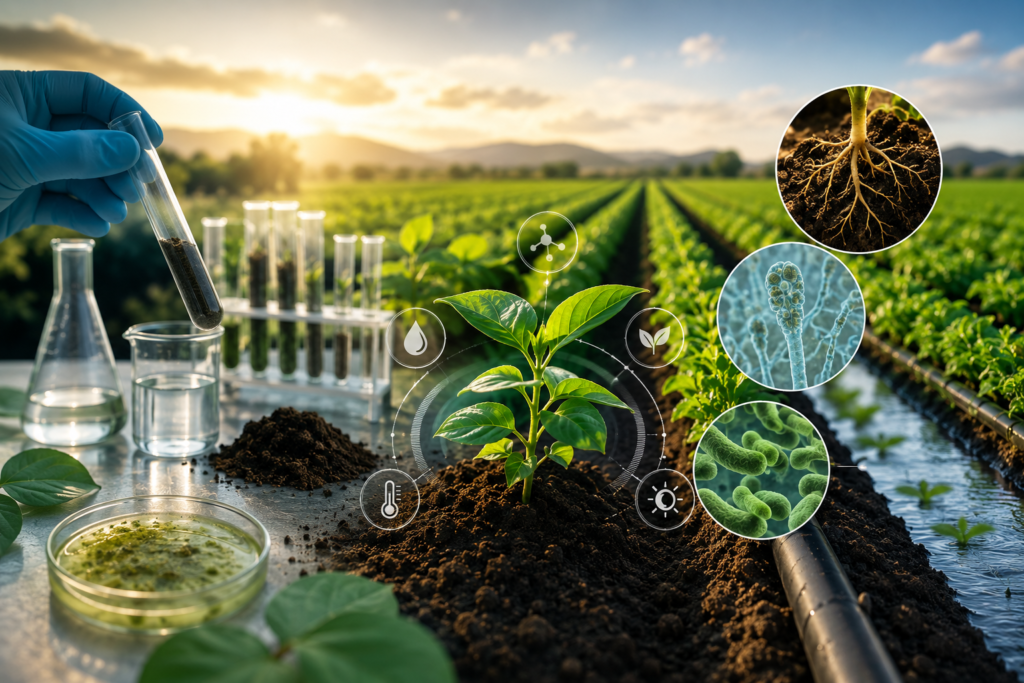
Today, implementing an agricultural analytics program is essential for crop production. These tools provide detailed insight into the physical, chemical, and biological conditions under which crops develop, making them a vital factor in strategic decision-making and the pursuit of maximum efficiency.
Agriculture is evolving rapidly to respond to global challenges such as climate change, the emergence of new pests, and the availability and quality of water. In this context, agricultural analytics has become the fundamental pillar for quality assurance and cost optimization.
Thanks to these tools, it is possible to apply the necessary nutrients and the specific chemical or biological products against phytopathogens, ensuring that plants maintain optimal nutritional and health balance at the lowest possible cost.
What Are Agricultural Analyses?
We define Agricultural Analyses as the set of diagnostic tools used to determine soil fertility, irrigation water quality, plant nutritional balance, and plant health. Their purpose is to accurately identify crop needs, care requirements, and deficiencies in order to maximize crop development.
Our analytical services specialize in three key areas:
- Plant Nutrition Analysis
- Phytopathological Analysis
- Microbiological Analysis
Plant Nutrition Analysis
These studies are essential before, during, and after every crop cycle. Their primary applications are divided into three key stages:
A. Before the Crop Cycle
- Land Evaluation: Helps determine whether to purchase or lease land by assessing its fertility and identifying potential physical or chemical limitations.
- Water Quality: Analyzes irrigation water to ensure its suitability.
- Post-Harvest Diagnosis: Determines the residual fertility of the soil for planning the next crop cycle by evaluating:
- The availability of nutrients for the plant’s initial development.
- Levels of elements that may cause toxicity (Sodium, Chlorides, Boron, etc.).
- Treatment Planning: Plans soil and water amendments for improvement.
- Input Quality Control: Verifies that the fertilizers to be used contain the concentrations indicated in their technical specifications.
B. During the Crop Cycle
- Precision Nutrition: Facilitates water and fertilizer management to formulate balanced nutrient solutions according to the plant’s phenological stage.
- System Monitoring: Evaluates nutrient solutions to ensure proper application through the irrigation system.
- Soil Paste Extract Analysis: Determines the actual composition of the soil solution and allows dynamic nutritional adjustments.
- Leaf Analysis: Determines the plant’s actual nutritional status and detects hidden deficiencies during development.
C. After the Crop Cycle
- Soil Reconditioning: Determines the final physical and chemical conditions of the soil in order to establish corrective treatments and soil improvement strategies for the next crop cycle.
Phytopathological and Beneficial Microorganism Analyses
Plant health has a direct impact on final crop yield. Phytopathological analyses of water, soil, and plants allow the early identification of biological limitations that may threaten crop production.
Likewise, Beneficial Microorganism Analyses quantify beneficial microorganisms that help counteract the negative effects of pathogens.
A. Before the Crop Cycle
- Species-Level Soil Phytopathological Analysis: Identifies nematodes, fungi, and bacteria with two clear objectives:
- Before disinfection: Determine the exact type and dosage of disinfectant required.
- After disinfection: Evaluate the effectiveness of the treatment.
- Beneficial Soil Microorganism Analysis: Measures the concentration of beneficial microorganisms remaining after disinfection to plan their restoration.
- Quality Control of Biological Products: Evaluates commercial biological products before application according to three criteria:
- Concentration: Confirms that the quantity of microorganisms matches the product label.
- Viability: Determines the percentage of living microorganisms capable of reproducing.
- Purity: Ensures the product contains only the declared species. The presence of undeclared strains is considered contamination that reduces product quality.
B. During the Crop Cycle
- Soil Monitoring: Tracks the phytopathogens detected at the beginning of the crop cycle to evaluate the effectiveness of disease management applications.
- Beneficial Microorganism Monitoring: Measures beneficial organism levels in the crop to determine whether additional applications are needed.
- Plant or Root Diagnosis: Accurately identifies the specific disease affecting the crop so it can be treated directly.
C. After the Crop Cycle
- Final Evaluation: The basic analyses are repeated to determine the final sanitary status of the soil and plan the resting or crop rotation period.
Microbiological Analyses and Food Safety
Ensuring food safety has become an essential requirement for protecting consumer health and accessing highly regulated export markets.
The importance of these analyses is based on three fundamental pillars:
| Pillar | Description |
|---|---|
| Regulatory Compliance | Ensures that products and processes comply with the microbiological limits established by current national regulations for food, drinking water, wastewater, and organic fertilizers. |
| Market Access and Certifications | Serves as the gateway to international trade. It demonstrates to foreign regulatory agencies (such as the U.S. FDA) that the crop complies with the required food safety and quality standards through accredited laboratories. |
| Quality Control and Prevention | Functions as an early warning system at Critical Control Points (CCPs). Detecting a pathogen early is considerably more cost-effective than dealing with product returns, recalls, or damage to brand reputation. |
In Which Matrices Are Microbiological Analyses Performed?
- A. Food Products (Fruits and Vegetables): Ideal for validating the effectiveness of post-harvest washing and disinfection processes.
- B. Living and Inert Surfaces: Evaluation of cutting tools, packing lines, and workers’ hands to prevent cross-contamination.
- C. Water: Microbiological monitoring of water used for irrigation, washing, or supplied by internal treatment and purification plants.
- D. Organic Fertilizers and Biostimulants: Controls the microbial load in composts and leachates to ensure product quality and prevent sanitary risks in the field.
Conclusion
Agricultural analyses are an indispensable strategic tool for informed decision-making in the agricultural sector. Their objective implementation makes it possible to diagnose the condition of soil, water, crops, and agricultural inputs, facilitating precision agronomic management, risk mitigation, and the efficient use of resources.
Beyond increasing productivity and quality, these analyses safeguard food safety and open the door to the world’s most demanding international markets. In a competitive and highly regulated agricultural environment, having reliable analytical data reduces losses and strengthens commercial confidence.
Agricultural diagnostics should not be considered an expense, but rather a key investment in achieving more efficient, safer, and more sustainable production.
